Manufacturing Management System: Putting Sequence Before Software
After several days of demos at IMTS, one pattern was hard to miss. Most of the operations leaders we met weren’t short on data or software. They were short on a working manufacturing management system, and many were about to spend money on technology to try to cover for it.
Here’s what we heard, and what we’d tell any executive weighing a digital investment.
Your ERP Is Holding Data Hostage
Several leaders described the same setup. Data goes into the ERP by scan or hand key, then nothing comes back out, with no analytics and no visualization. The ERP becomes a very expensive black hole: plenty goes in, and nobody turns it into actionable information.
Others were in the middle of an ERP migration or a manufacturing software implementation. They said it has been taking them years without a clear ROI. In the meantime, the shop floor runs on whatever holds it together: whiteboards, spreadsheets, someone retyping numbers. Years of that isn’t a rounding error. It’s years of decisions made on stale or missing data and solving problems that are already in the rearview mirror.
Ask what that costs in your plant. Not the software. The delay, the rework, and the problems found on Friday that started on Monday.
The Make-vs-Buy Question Is Really a Focus Question
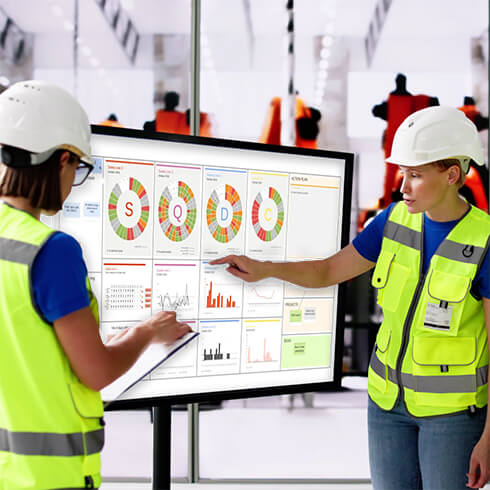
One site leader looked at our digital boards and said something we took as a compliment: “This looks simple. Should I just hire a developer for a year and build it myself?”
Fair question. Then we discussed that for about a minute. You’d be building the tool, and then maintaining it, training on it, and improving it, and you’d be doing it while running a plant. You are a manufacturer. Building software to manage manufacturing is a second business you don’t want to be in.
Buy the tool. Spend your time on the part that needs your focus, which is running the operation.
One System, Not Another Dashboard
The most useful question we heard from executives was “how does this help my team make better decisions faster?”
One VP of Operations at a machine shop already had visualization through Power BI. His concern wasn’t seeing the data. It was that seeing it didn’t move anything. Data on a screen without owners, cadence, and follow-up quickly turns to wallpaper.
Others asked whether the tools were standalone or integrated. Many visitors already ran pieces of a digital system across paper, Excel, and Power BI. What they valued was having it in one connected, out-of-the-box system: production tracking, project management, leader standard work, all in one place, all tied to actions.
When we showed the entire Digital Management System, together in one connected experience, people quickly understood the purpose. If your team is adding another dashboard to an already crowded stack, stop and ask what’s connecting them.
The Sequence Matters More Than the Software
Many visitors told us the same thing: they tried lean, or hour-by-hour tracking, or SQDC boards, and it didn’t stick. Very few said they’d built a working management system and then failed to digitize it. They never got the system running in the first place.
That points to the mistake we see most. Companies buy the platform first and try to build a manufacturing management system inside it. That’s backwards. Do it in this order:
- Build and formalize the management system. Define standard work, cadence, metrics, escalations, and help people develop the desired skills and behaviors.
- Then digitize it. The technology should make a working system visible, faster, and easier to sustain.
- Start narrow. People hear “40 rooms and unlimited boards” and think enterprise-wide rollout. Most need to start with a Proof of Concept. Test the management system and demonstrate scalability, then grow.
The lesson here is to be clear about what good looks like for your business and then digitize it.
The Part Executives Underestimate: Sustainment
An operations manager at the show described a previous digital system where new frontline hires arrived, looked at a screen full of SQDC data, and were never trained on it. There was no onboarding plan and no sustainment plan. The data was there, and the habit wasn’t.
Two things stand out from our own field experience. First, don’t declare victory early. New cadences take time to become the way you do business, and that takes leader sponsorship, a champion, and steady follow-up. Second, build internal ownership from day one. Name a local expert inside your organization who can build a board, adjust a metric, and coach the next person, so you’re not waiting on an outside resource for every change.
Your Move
Before deciding technology is the answer, ask yourself three questions:
- Do we have a formal management system in place today, with standard work, cadence, and escalation?
- Can our people act on the data we already collect?
- Do we have the capability to lead change?
If you can’t answer yes to all three with confidence, let us help you fix those first. It’s what makes the software worth buying. This is the work TBM has done for more than 35 years: designing, rolling out, and sustaining management systems across industries. We’ll help you build the foundation, then show you how digital makes it stick.
Ready to find out where you stand? Talk to our team about a management system assessment or a digital management system demo.
The leaders closest to your shop floor told us something at IMTS that every executive should hear. Read what supervisors had to say.