Why Inspection Heavy Quality Management Are Undermining Manufacturing Performance
In regulated manufacturing environments—pharmaceuticals, medical devices, food, packaging—adding quality checks often feels like the responsible thing to do. Each new inspection promises lower risk, stronger compliance, and greater customer confidence.
But across many operations, the opposite is occurring.
As inspection layers multiply, organizations are experiencing higher labor cost, slower throughput, and persistent quality issues, not because people don’t care about quality, but because the system is designed to catch defects instead of preventing them.
For manufacturing leaders responsible for throughput, margin, and compliance, this creates a growing operational dilemma: At what point does protection become a performance liability?
When Inspection Replaces Process Control
Quality checks are meant to protect the customer. But when inspection points proliferate—operator checks, secondary checks, supervisor approvals, audits—they often become a substitute for addressing root causes.
Instead of asking: “Why did the process allow this defect to occur?”
Organizations begin asking: “Who missed it?”
That shift signals a deeper issue. Each additional check quietly communicates:
- We don’t trust the process
- We don’t trust variability is under control
- We don’t have a reliable way to identify and eliminate root causes
At that point, inspection stops being a control mechanism and becomes an admission that the process itself is unstable.
The Emerging Waste Executives Rarely See: Over Inspection
Lean manufacturing leaders are trained to look for waste—motion, waiting, inventory, overproduction. Yet across our client engagements, another form of waste is increasingly visible: Inspection waste.
Over inspection shows up as:
- Skilled labor checking instead of producing
- Bottlenecks at quality gates that constrain throughput
- Data collection that isn’t used to drive decisions
- Rework loops driven by inconsistent interpretation
- Cultures that reward defect detection rather than prevention
This waste carries real economic consequences:
- Capacity is consumed without increasing output
- Defects are discovered later, when correction is most expensive
- Leadership visibility decreases, even as reporting increases
This is cost disguised as control.
The direct monetary impact of reactive quality management on manufacturing operation
- Cost of Poor Quality (CoPQ) level: Studies and industry benchmarks show poor quality can run 15–20% of sales in many manufacturers, and typically 15-20% of total operations when quality is weak and reactive.
- Inspection and appraisal spend: Over-reliance on inspection pushes up appraisal costs (inspection, test, audits, reviews) without preventing defects, so you pay heavily to detect problems late instead of designing them out.
- Rework, scrap, and yield loss: Defects found late in the process drive rework hours, scrap, extra material, and overtime, often representing millions annually for mid to large manufacturers.
- Service, warranty, and recall costs: External failures (field complaints, returns, warranty replacements, product recalls) are among the most expensive consequences of reactive inspection and can reach billions in lost revenue across the sector.
Example:
A 1 million unit run at 4% defects with a unit cost of 50 USD produces 2 million USD in direct failure cost; adding 5 USD per unit of inspection adds another 200,000 USD, with total poor-quality cost of 2.2 million USD just on that batch. (Source: Autodesk)
What TBM Sees in the Field
In our work with manufacturing leaders, quality problems rarely stem from a lack of inspection. They stem from inconsistent management systems and limited visibility into process performance.
For example, a global frozen food manufacturer with approximately 50 production facilities was struggling to make meaningful progress in safety, quality, and productivity. Despite significant effort, performance remained stagnant and earnings had plateaued. The organization relied heavily on traditional controls and local autonomy, but lacked a consistent, enterprise-wide approach to quality assurance and performance.
Rather than adding inspection layers, we partnered with senior leadership to launch a global Lean manufacturing transformation—creating a standardized continuous improvement program deployed across 48 plants worldwide. The focus was not on checking quality downstream, but on building quality assurance into daily operations through disciplined management practices, preventive maintenance, and improved visibility into process performance.
The results were both operational and financial:
- $15–$20 million in annual global savings
- Average $300,000–$600,000 in savings per plant
- Sustained improvements in quality, productivity, and asset utilization
- A scalable management system that enabled performance gains without increasing inspection intensity
Quality improved not because more defects were caught—but because process instability was addressed earlier and more consistently across the enterprise.
In another case, a global medical device manufacturer struggled with backorders, excess WIP, and reliability issues following rapid growth and acquisitions. TBM worked with leadership to implement a visual management system focused on abnormality response and accountability, instead of increasing inspection layers.
Results included:
- 20%+ productivity improvement
- 85% reduction in line side WIP
- A $1.3M backorder eliminated on a single product line
- Improved reliability without additional quality gates
In both cases, quality improved not because inspection increased—but because process understanding and response speed improved.
Inspections Don’t Prevent Defects—Processes Do
More inspections create the illusion of safety:
- If we check enough, nothing bad escapes.
- If someone signs off, we’re protected.
The reality is harsher:
- Inspections detect defects after they occur
- Human vigilance declines in repetitive tasks
- Variation increases with more handoffs
- Late detection multiplies cost and disruption
Operational excellence is not built on catching mistakes. It’s built on designing processes that don’t create them.
The Leadership Shift That Changes the Math
This is not a quality department problem. It’s a leadership decision.
Manufacturing leaders face a clear choice:
- Continue investing in inspection layers to offset unstable processes
- Or invest in quality management systems that make problems visible, solvable, and preventable
Leading organizations are choosing the latter—moving away from inspection heavy models toward digital management systems and disciplined daily control, where abnormalities surface early and root causes are addressed systematically.
In highly regulated environments, TBM has consistently seen that speed, compliance, and quality improve together when management systems make performance gaps visible and actionable—not buried in reports or audits.
From Inspection to Insight: Enabling Prevention at Scale
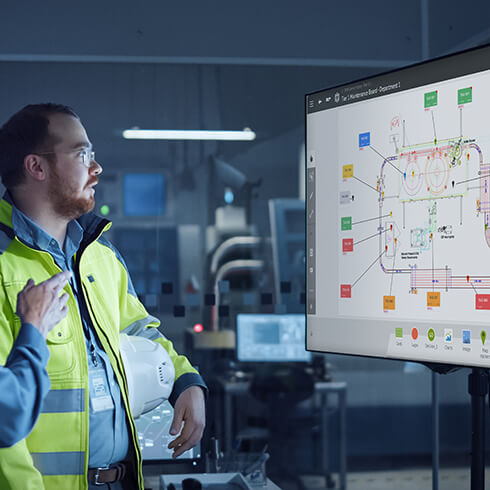
Digital visual management platforms enable this shift by:
- Making process instability visible in real time
- Connecting quality, yield, and delivery at every level
- Anchoring problem-solving in data, not opinion
- Enforcing disciplined escalation rather than adding checks
One platform enabling this transition is TBM’s Digital Management powered by iObeya, which brings TBM’s proven management system into a digital environment that supports daily control, cross-functional collaboration, and leadership visibility.
When combined with AI-enabled analytics, leaders gain the ability to:
- Identify defect patterns earlier
- Spot correlations humans miss
- Focus effort where risk is building—not where it already failed
The result is fewer inspections, fewer surprises, and stronger control with less friction.
The Real Question for Manufacturing Leaders
Quality checks are not the enemy. Using them as a shield instead of a tool is.
The real question facing manufacturing leaders is this: Are quality checks compensating for unstable processes…or reinforcing them?
Organizations that continue adding inspection layers will spend more each year for diminishing returns. Those who invest in visibility, discipline, and data-driven problem-solving will improve both quality and performance.
Operational excellence requires courage—the courage to stop checking symptoms and start fixing systems. We’re here to help you implement a discipline that drives faster decisions, stronger performance, and lasting results.