The Hidden Cost of Running Two Businesses on One Shop Floor
I’ve spent enough years walking shop floors for TBM to recognize the moment before anyone says it out loud: the scheduler pulls up the board, and you can already tell everything is urgent and nothing is on time. I saw it again on a recent client visit, and it’s what most manufacturers miss — they don’t realize they’re running two different businesses out of the same building, one that makes to stock and one that makes to order, until the two start fighting for the same capacity, the same schedule, and the same attention. That fight doesn’t show up on the P&L, and it doesn’t show up in the SIOP deck. It shows up at 4 p.m. on a Thursday.
It’s the kind of problem I’ve helped clients work through myself, but I wanted more than my own take on it. So I sat down with two of TBM’s most experienced operators — Bill Remy, CEO of TBM Consulting Group, and David Pate, Vice President of TBM’s Operational Excellence Practice — and asked them to hash it out. Between the two of them, they’ve walked into this fire more times than either can count, and they don’t see it the same way. Pate is the numbers guy — show him the demand pattern and he’ll show you the segmentation model that fixes it. Remy is the commercial guy — he doesn’t care how clean your production schedule is if sales and pricing are quietly wrecking it. I put them in the same conversation because that tension is exactly where the real diagnosis lives, and neither of them let the other off easy.
How Two Businesses End Up Sharing One Floor
It starts small: a plant that mostly makes the same things, the same way, every week. Predictable. Then a customer wants something custom. Then another. Pretty soon there’s a second business quietly living inside the first — different volumes, different variability, different rules — sharing the same line, the same schedule, the same priority stack. For a while, that’s fine.
Where the Segmentation Breaks Down: Make-to-Stock vs Make-to-Order
Then the first rush order lands. It jumps the queue because it has to, and everything behind it slips. Slipping orders become late orders. Late orders become urgent orders. “What companies do is [run] the urgent stuff, and then other things become urgent because they’re behind and they’re short, and those orders then become urgent. It becomes a death spiral,” Pate says.
Remy’s read on the root cause is blunter: “The biggest challenge is people don’t actually segment their demand. They don’t differentiate.” Almost every plant like this is already running two businesses — make-to-stock and make-to-order — and almost nobody will admit it.
Pate draws the map most companies never bother to draw: demand that’s steady and predictable enough to run on a pull system; a middle tier that’s lower-volume but still forecastable, worth stocking; and true make-to-order work that’s genuinely unpredictable and shouldn’t be forced into a forecast at all. Three different demand patterns, three different rulebooks, one shared floor, and a production schedule built around “pattern wheels” that carve up capacity by segment and actually hold it all together.
But a clean production schedule isn’t enough on its own, and Remy doesn’t let the conversation stop there. The math is downstream of a decision nobody’s made yet: sales, pricing, and lead times have to be built around the same segmentation, or no scheduling trick on earth saves you. Make-to-stock customers get next-day shipping because it’s on the shelf, no excuse. Make-to-order customers get an honest lead time, because the raw material probably hasn’t even been bought yet. Mix those promises up, and the floor pays for it.
What It’s Actually Costing You
In a make-to-stock world, inventory absorbs the shock — demand jumps, you pull from the shelf, nobody feels it. Make-to-order doesn’t get that cushion. There are only two levers left: capacity, or lead time. Pate points to a large industrial HVAC equipment manufacturer as the cautionary case: demand climbed, production stayed inefficient, and lead times stretched so far that lead time itself became the shock absorber. Customers weren’t waiting on a unit. They were waiting on the company to catch up to itself.
Then there’s the money question every CFO should be asking. Pate has seen it firsthand: an industrial container manufacturer whose standardized, high-volume products were quietly funding the business, while the custom, engineered-to-order line bled it dry and got the same sales attention as the products actually making money. Remy’s line on that lands like a verdict: “The thing they make no money at, that they make twice a year, gets the same level of attention as the 80% they make every month. That’s just nuts.”
The Fix — And Why Rationalizing SKUs Comes Last
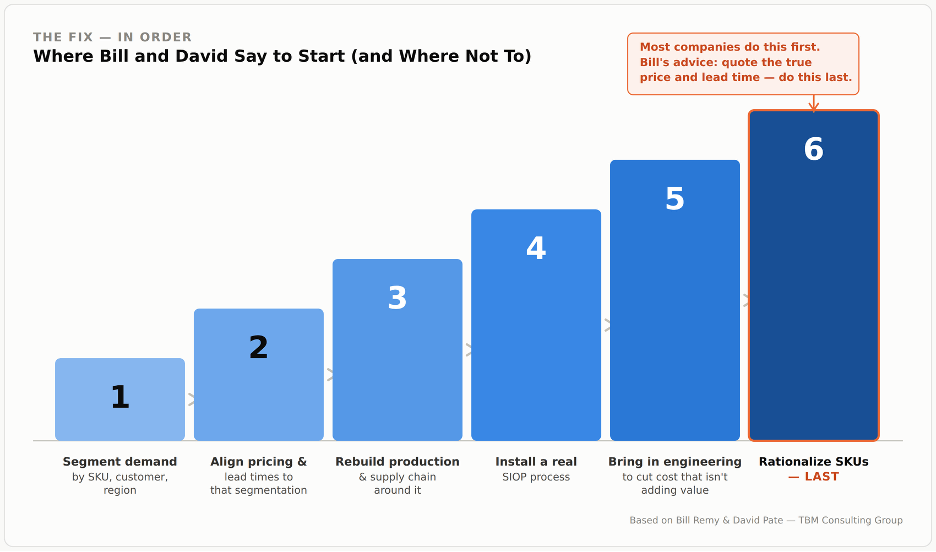
At this point I asked them the question I always ask when a client is starting from zero: what would you tackle first? Pate didn’t hesitate — demand segmentation, every time, because it’s the information that tells you what to make, what not to make, and what your production and supply chain need to look like to support it. Remy built on it from there, and between them the sequence looks like this:

Most companies want to do that last step first: cut the weird stuff, simplify the catalog, done. Remy’s advice is the opposite — quote the true price and the true lead time on the oddball item and let the customer decide whether they still want it. His line to a hypothetical customer: “How bad do you want that one color? Because you’re the only guy I painted that color for.”
The sales team isn’t the villain here. They’re playing the game as it’s scored. Measured on revenue, they’ll take the low-margin custom order every time. Remy’s fix is blunt: realign commissions so that selling the wrong thing costs something. “If you sell one of these dogs with fleas, I’m going to give you a negative commission,” he says. “It’s the hot stove, man. And they will align accordingly.” Change the scoreboard, and a sales team stops taking orders and starts acting like technical advisors asking why before quoting how.
The Sharpest Version of This: No Fixing It After You Sign
Everything above assumes you get to adjust as you go: re-segment, reprice, rebalance capacity as the mix shifts. If you’re a tier supplier signing a long-term agreement in automotive or aerospace, you don’t get that luxury. The segmentation has to be right before the contract is signed, because the mix is locked for the life of the deal. Remy lived this on a Boeing long-term agreement that bundled every platform together: “I loved the 737 stuff at 40 ship sets a month. I hated the 747 stuff at one ship set a month.” No renegotiating — that’s the deal you signed. It’s the same lesson as everything above, just with the stakes turned all the way up: segment before you commit, because you may not get a second chance to rationalize your way out.
What It Takes to Pull This Off
None of this is complicated in theory: segment the demand, align the promises to it, build a real planning process, rationalize last, not first. What’s hard is doing it inside a real company, with real habits, and a sales team scored on the wrong number. Remy’s estimate, starting from zero: one to two years. “That’s the other thing I think people underestimate,” he says, “how long it takes to really get this right.”
What struck me listening to the two of them go back and forth is how consistent the answer was underneath their disagreement — demand segmentation first, commercial alignment right behind it, rationalization last, every time. If your plant feels like it’s negotiating make-to-stock vs make-to-order every day, you’re not imagining it, and you’re not the first to run into it. It’s a solvable problem — let’s talk about what solving it looks like for yours.